

Phoenix’s commercial real estate market is outperforming the nation at mid-year, but the environment is more complicated than the headlines suggest.
Demand is strong. Construction is constrained. Costs are higher. The national forces affecting capital markets haven’t resolved; they’re just better understood.
Here’s what’s driving the market and what to watch in the second half of 2026.
Phoenix Industrial Just Had One of Its Best Quarters on Record
The numbers from Q1 2026 are hard to ignore.
According to LGE Design Build’s Q2 2026 Construction Delivery Outlook Report, Phoenix industrial posted:
- 7.5 million SF in total lease transactions (one of the strongest quarters in recent memory)
- 4.4 million SF absorbed
- Vacancy down 120 basis points to 12.4%
- Class A space has accounted for 67% of total leasing year-to-date
- Asking rents up 5% to $1.18 per square foot, triple net
- New deliveries dropped 82% year-over-year (the lightest volume since Q1 2019)
The broader picture is a market that is tightening: demand remains active, space is being absorbed, rents are rising, and new deliveries have slowed sharply.
Tighter vacancy and rising rents are good signals for brokers and lenders active in this sector. And for large tenants, the window to lock in quality space is getting smaller.
The Rest of the Market Is Quietly Recovering
Industrial gets the headlines, but other sectors are also worth paying attention to.
Office
- Vacancy dropped 50 basis points to 22.8% in Q1, with absorption more than doubling from Q4 2025.
- Landlords are investing heavily in spec suites and amenities to compete for tenants, and it’s working.
- New office construction is rare almost everywhere right now, which makes Phoenix’s handful of build-to-suit headquarters projects (Sprouts Farmers Market, Fender Music, Republic Services) a real signal of corporate confidence.
Retail
- Phoenix retail is one of the tightest commercial sectors in the metro.
- Vacancy hit 4.5% in Q1, with asking rents up nearly 7% year-over-year.
- The pipeline is down more than 22% year-over-year, keeping supply tight.
- National retailers are making long-term bets on the West Valley.
Hospitality
- Phoenix’s hospitality pipeline is up 19% year-over-year, making it one of the most active in the country.
- The action is concentrated in Downtown Phoenix, North Phoenix near the TSMC campus, and the West Valley.
Multifamily
- CBRE projects Phoenix is among the Sun Belt markets where asking rent growth will stay negative or near zero for much of 2026. The market is still absorbing a big wave of new supply.
- Long-term fundamentals are solid: job growth, in-migration, and housing costs all continue to push people toward renting.
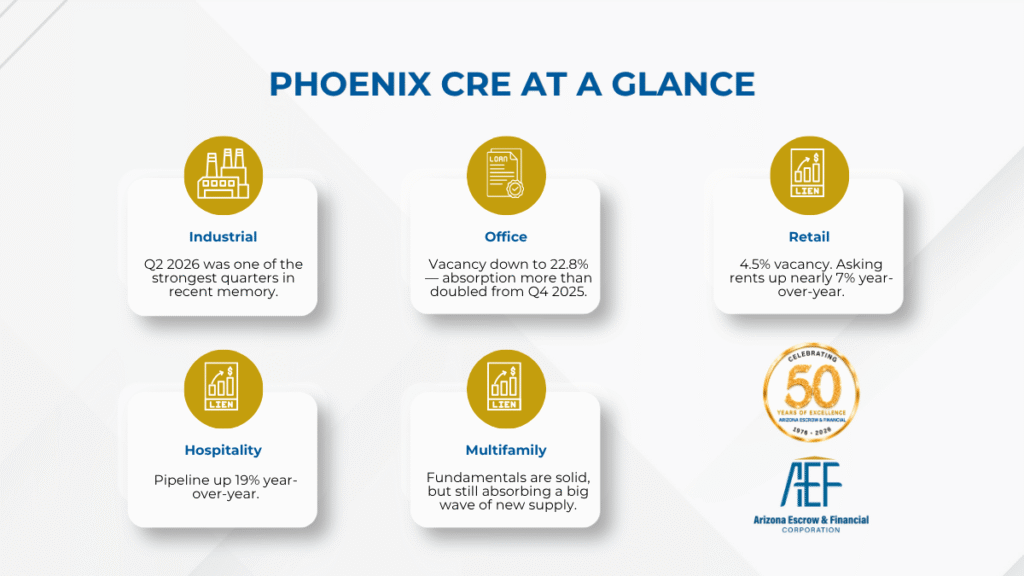
Overall, most sectors in Phoenix are moving in the right direction. Multifamily is the exception to watch more closely.
Construction Costs Are Higher, and They’re Staying That Way
Industrial construction prices rose when new tariffs were introduced in 2025. They haven’t come back down, but volatility has stabilized, making planning easier.
Cushman & Wakefield’s analysis puts current materials costs at about 6% above the 2024 baseline, with total project costs running roughly 3% higher. At the 2025 peak, materials were tracking toward 9% above baseline.
What that looks like on the ground in Phoenix, per LGE’s Q2 report:
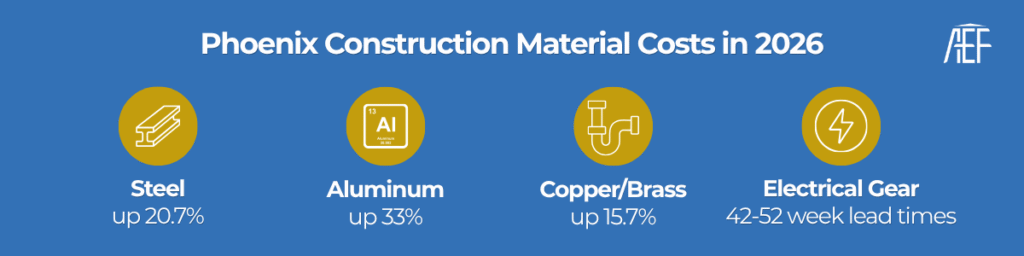
- Steel: up 20.7% year-over-year
- Aluminum: up 33%
- Copper and brass: up 15.7%
- Electrical gear and large panel distribution boards: 42-52 week lead times in Arizona
Tariffs have reset pricing at a higher baseline. Returns, feasibility thresholds, and project timelines all need to be recalibrated accordingly.
For anyone developing, financing, or underwriting a new project right now, the old cost assumptions don’t apply. Early procurement on long-lead items is essential.
Arizona Is Becoming a Data Center Powerhouse (With Complexities)
Arizona ranks 7th nationally in total data centers (184 operational, 86 more planned). Phoenix ranks 4th among North American data center markets.
Nationally, CBRE reports that 2026 data center pre-leasing is running at around 75% of space under construction, nearly double the historical norm of 40-50%.
Demand isn’t the problem. Supply is.
The bottleneck isn’t land; it’s power.
Large AI campus developments now require multiple on-site substations, with interconnection timelines stretching to 24, 36, or even 48+ months in some cases.
The scale of these projects has also changed dramatically. The average data center land transaction hit 224 acres in 2024 (up 144% in just two years).
That scale is adding new layers of complexity to transactions, such as:
- Co-insurance arrangements, where multiple title insurance companies share liability because deal sizes exceed what any single insurer will carry alone
- Mineral rights due diligence, with buyers seeking assurances that subsurface rights won’t disrupt facility operations, utilities, or future expansion plans
For brokers and attorneys working on these transactions, the due diligence and closing process looks very different from what it did even a few years ago.

The National Picture: Rates Are Holding, But Capital Is Moving
The rate environment isn’t going away, but it’s not stopping transaction flow either.
CBRE forecasts just two Fed rate cuts in 2026, landing the target range at 3.0-3.25%. The 10-year Treasury could end the year below 4%. Economists surveyed by Reuters now expect the Fed to hold longer than markets anticipated at the start of the year.
Here’s what matters more: capital is moving anyway. CBRE projects U.S. CRE investment volume up 16% in 2026 to $562 billion, nearly matching the pre-pandemic annual average.
Sellers are getting more realistic on pricing. CBRE executed more confidentiality agreements with prospective buyers in 2025 than any year since 2022. The market is thawing.
A few things to keep in mind on the financing side:
- Fixed-rate CRE loans are priced off the 10-year Treasury, not the Fed funds rate. Rate cuts won’t translate directly to lower borrowing costs
- Cap rates are expected to compress 5-15 basis points across most property types, with higher-quality assets seeing the most movement
- Debt markets remain healthy. Liquidity is available from both public and private sources
The Phoenix advantage: Strong local fundamentals, such as low vacancy, rising rents, and the TSMC semiconductor ecosystem, mean that quality Phoenix assets are worth pursuing at current rates. Buyers here aren’t waiting for the Fed.
The Bottom Line
Phoenix is outperforming, but the second half of 2026 will reward preparation over optimism.
The transactions getting done in this environment are more complex, and the details matter more than ever.
After 50 years working exclusively in commercial and business escrow, that’s exactly the kind of environment AEF is built for, whether it’s a straightforward commercial closing, a multi-lender structure, or a transaction with an account servicing component.

Disclaimer: Arizona Escrow & Financial Services makes no express or implied warranty regarding the accuracy, completeness, or reliability of the information provided and assumes no responsibility for errors or omissions. The information presented is for general informational purposes only and should not be considered legal, financial, or professional advice.
Arizona Escrow & Financial Services, the Arizona Escrow logo, and www.arizonaescrow.com are trademarks or registered trademarks of Arizona Escrow & Financial Services and/or its affiliates. Unauthorized use of these trademarks is strictly prohibited.
For more information, please visit www.arizonaescrow.com or contact us directly.

Monica May-Dunn
Monica May-Dunn is the Owner, CEO, and CFO of Arizona Escrow and Financial Corp., a leading provider of business escrow services since 1976. With over 30 years of industry expertise, she has expanded AEF’s portfolio, driven record growth, and launched a leadership podcast. Recognized as one of AZRE’s “Most Influential Women in Commercial Real Estate 2024,” she is a strategic leader, mentor, and active voice in industry innovation.
Table of Contents
Categories
Recent Posts
Quick Links
Disclaimer: Arizona Escrow & Financial Services makes no express or implied warranty regarding the accuracy, completeness, or reliability of the information provided and assumes no responsibility for errors or omissions. The information presented is for general informational purposes only and should not be considered legal, financial, or professional advice.
Arizona Escrow & Financial Services, the Arizona Escrow logo, and www.arizonaescrow.com are trademarks or registered trademarks of Arizona Escrow & Financial Services and/or its affiliates. Unauthorized use of these trademarks is strictly prohibited.
For more information, please visit www.arizonaescrow.com or contact us directly.