

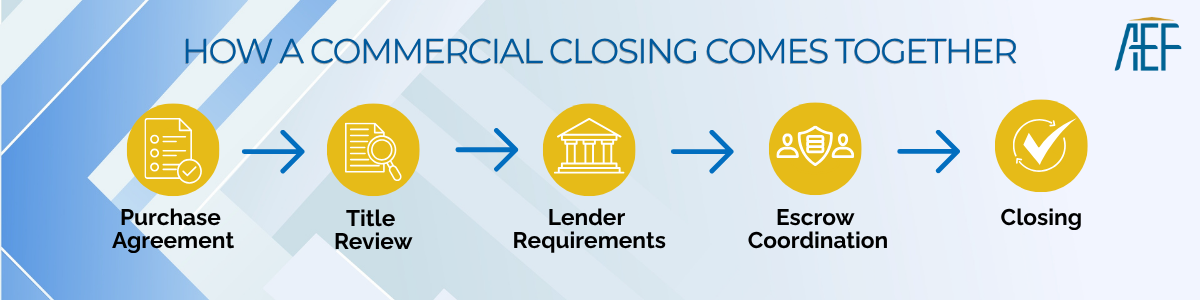
By closing day on a commercial property, half a dozen or more professionals have usually had their hands on the file. Counsel on both sides negotiated the purchase agreement and the brokers spent weeks keeping dates from slipping, while the lender worked through underwriting, and the title and escrow teams cleared requirements in the background.
Each party relies on information or documents from the others.
Title and escrow sit right in the middle of it. The title company examines the property’s title and insures it. Escrow coordinates the funds and documents involved in the closing and carries out the transaction under written escrow instructions.
This article covers the differences between title search, title insurance, and escrow, as well as the importance of their coordination in a commercial transaction and two recent legal changes that affect both title and escrow
What Does a Title Commitment Show?
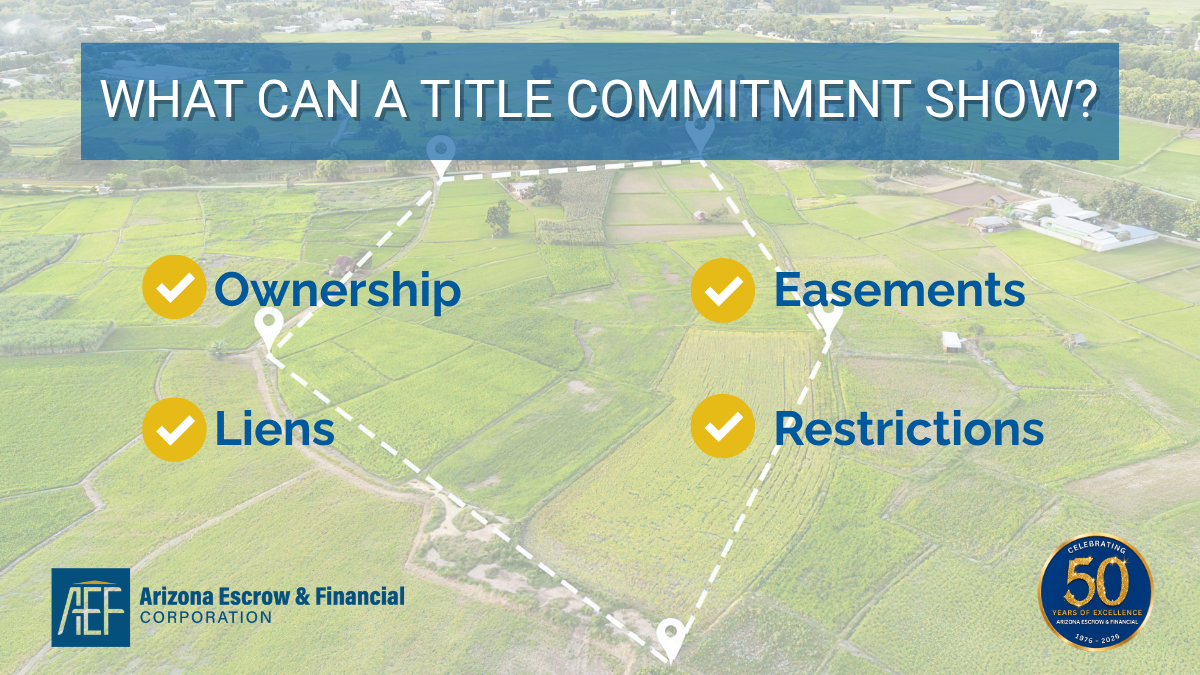
A title commitment is based on a review of the public records tied to a property and lays out matters recorded against its title. A standard limited report search may not include all of these items. On a commercial property, a title commitment may include:
- The current vesting and chain of title
- Deeds of trust, mortgages and assignments of rents
- Judgment, tax and mechanics’ liens
- Easements, CC&Rs and reciprocal easement agreements
- Memoranda of lease and other recorded tenant interests
- Lis pendens and other notices of pending litigation
The title commitment is where any problems first come to light. A lender wants to confirm that no other lien will be paid ahead of its loan. A buyer’s counsel looks for easements or restrictions that could limit how the property is used and raises any objections before the deadline in the purchase agreement.
If the search turns up an old lien that must be paid off, the broker wants to know right away, because that payoff happens through escrow at closing and can push back the closing date.
What is Title Insurance?
Title insurance is a policy that protects the insured owner or lender against loss from covered title defects.
The title commitment feeds into the policy, since it outlines what the insurer is willing to insure and on what terms. Every policy is subject to its own exceptions, exclusions, and conditions.
The title commitment comes first. Before a policy issues, the insurer sends a commitment laying out its terms. On the standard ALTA form, the key parts are:
- Schedule A: who will be insured, the policy amount, and the interest being insured.
- Schedule B, Part I (requirements): what has to happen before the policy issues, like recording a release, delivering entity authority documents, or paying off a loan.
- Schedule B, Part II (exceptions): matters the policy won’t cover unless they’re cleared.
Most of the negotiation happens in Schedule B. Buyer’s counsel may object to exceptions, ask for endorsements covering issues like zoning, access or contiguity, and check whether a new survey will let the insurer remove or narrow the general survey exception. Lenders set their own title insurance requirements in their closing instructions, so those need to line up with the commitment too.
The Role of Escrow
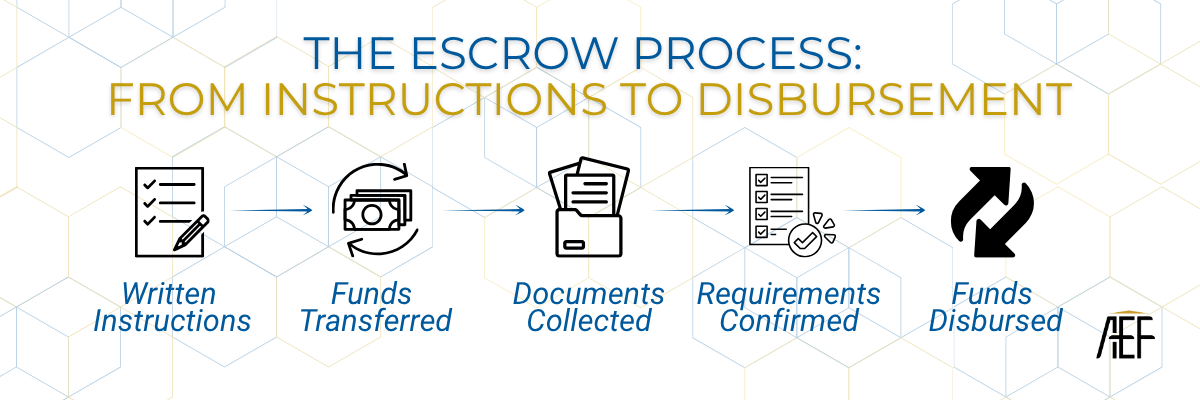
Escrow is the neutral third party in a commercial closing, coordinating the documents and movement of funds required under the escrow instructions. The escrow agent doesn’t represent the buyer, the seller, or the lender. They work from the escrow agreement which the parties have agreed to in writing.
What escrow handles on a typical commercial file:
-
- Coordinates the earnest money deposit and other transaction funds
- Collects signed documents, payoff demands and the lender’s funding instructions
- Prepares the settlement statement for the parties to review
-
- Tracks the documents, funds, instructions and authorizations needed before closing
- Disburses funds and works with title on recording
The three roles at a glance:
- Title search identifies recorded matters affecting the property.
- Title insurance protects the insured against loss from covered title defects, subject to the policy’s terms.
- Escrow carries out the transaction according to the escrow instructions.
Title and Escrow are Separate Roles
Title and escrow are both essential to a commercial closing, and they’re frequently viewed as a single service. However, they are two distinct roles, each with its own responsibilities, timeline, and expertise.
The company handling one role isn’t automatically a specialist in the other. That distinction matters most in business sales and complex commercial real estate transactions, where escrow instructions, payoff figures, and multi-party disbursements call for focused escrow experience.
Commercial escrow and closing coordination is Arizona Escrow & Financial’s specialty. For title, we work with several partner title companies to coordinate title searches and title insurance for our clients. Clients get a dedicated escrow team without needing to search for a title company on their own.
Why Coordination Matters Across the Transaction Team
Every party on a commercial closing holds something the others need, so when one part changes, it usually shows up in someone else’s work.
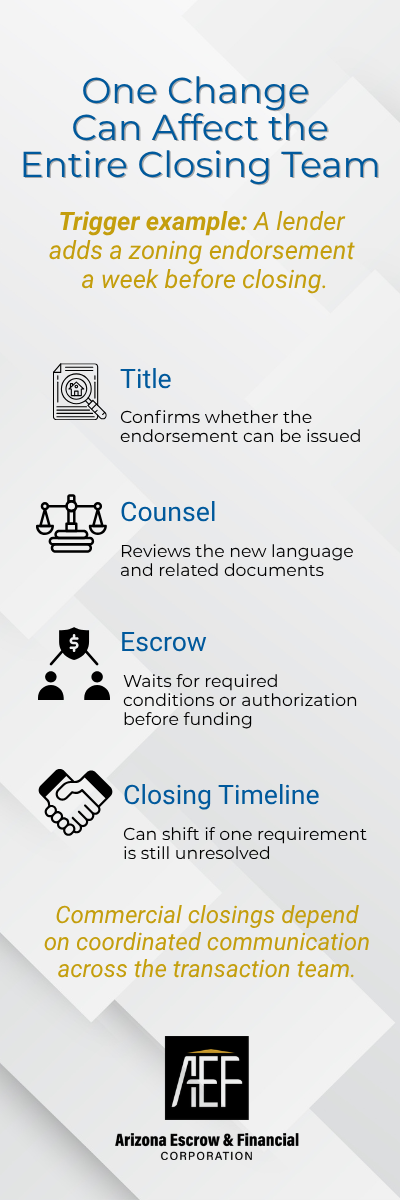
For example, if a lender adds a zoning endorsement to its requirements a week before closing, title has to confirm it can issue the endorsement, counsel may want to review the new language, and escrow may not be able to proceed with funding until the lender’s required conditions are satisfied or the appropriate authorization is received, so one late change touches four parties.
Attorneys review the commitment and survey, prepare or approve closing documents and give escrow its instructions. When counsel clears an exception or revises a document, that change can reach the policy, the settlement statement and what escrow is authorized to release, so it helps to send the update to title and escrow at the same time.
Much of the day-to-day communication runs through brokers, who track contingency dates, gather signatures and field status calls. Because they see the whole timeline, brokers are often the first to notice when a title requirement is still waiting on an answer.
Loan proceeds can’t be disbursed until the lender’s conditions are met. Lenders can help keep things on schedule by sending their title requirements, endorsements and funding instructions to escrow early, in terms that match what title is prepared to insure.
For title professionals, the focus is the Schedule B-I requirements from the title work. Many of those are satisfied through escrow, whether that’s a recorded release, an entity resolution or a loan payoff.
Escrow agents need the right instructions, documents, and funding in place before they can carry out their part of the closing. If two sets of instructions don’t match, escrow points out the difference and waits for the parties to agree on how to proceed.
What’s Changing in 2026
Two updates this year are good examples of why that coordination matters, since each one touches title, escrow, and legal review.
Arizona SB 1479: Recording and Notarization
Governor Katie Hobbs signed Senate Bill 1479 on April 9, 2026, to help combat deed fraud in Arizona. The Arizona Legislature’s bill summary outlines four main changes:
- Photo ID for in-person recording. Documents recorded in person at a county recorder’s office or kiosk need valid photo ID. Escrow and title offices, banks and credit unions, Arizona State Bar members and government entities are exempt.
- Notary thumbprints. Notaries must take the signer’s thumbprint in their journal for deeds, other real property instruments and powers of attorney. Remote online notarizations are exempt if the notary keeps the audio-video recording for at least seven years.
- Tougher penalties. Knowingly recording a forged or false claim against real property is now a class 5 felony, up from a class 1 misdemeanor.
- Owner alerts. County assessors must offer owners opt-in alerts for changes in ownership or mailing address by January 1, 2027.
For commercial closings, the thumbprint rule has the most day-to-day impact. If you’re arranging signings for out-of-state principals, reviewing a remotely notarized deed or accepting a closing package from another state, it’s worth confirming each notarization meets the new rules before the documents go to record.

2026 ALTA/NSPS Land Title Survey Standards
The updated Minimum Standard Detail Requirements for ALTA/NSPS Land Title Surveys took effect February 23, 2026, replacing the 2021 version. Among the changes, surveyors now gather record descriptions of adjoining parcels themselves, note owner or occupant statements about title or boundary issues on the plot, and work under a revised definition of Relative Positional Precision.
Because the survey feeds several reviews at once, these changes reach most of the team. Title uses it to decide whether survey-related exceptions can be modified and counsel checks it against the commitment, while lenders often build survey requirements into their closing conditions. To help keep that review on schedule, send the commitment to the surveyor early, reference the 2026 standards in the survey order and flag any Table A items the lender requires.
Arizona Escrow & Financial’s Role on the Transaction Team
Arizona Escrow & Financial serves as the neutral escrow party on commercial and business transactions, coordinating documents, disbursing funds, and carrying out the steps the parties’ instructions assign to escrow. Much of that work is keeping counsel, brokers, lenders, and title in the loop so open items surface while there’s still time to handle them.

If you’re working on an upcoming commercial transaction, take a look at our escrow services or reach out to discuss how AEF can work alongside your team.
Disclaimer: Arizona Escrow & Financial Services makes no express or implied warranty regarding the accuracy, completeness, or reliability of the information provided and assumes no responsibility for errors or omissions. The information presented is for general informational purposes only and should not be considered legal, financial, or professional advice.
Arizona Escrow & Financial Services, the Arizona Escrow logo, and www.arizonaescrow.com are trademarks or registered trademarks of Arizona Escrow & Financial Services and/or its affiliates. Unauthorized use of these trademarks is strictly prohibited.
For more information, please visit www.arizonaescrow.com or contact us directly.

Annette Anderson
Table of Contents
Categories
Recent Posts
Quick Links
Disclaimer: Arizona Escrow & Financial Services makes no express or implied warranty regarding the accuracy, completeness, or reliability of the information provided and assumes no responsibility for errors or omissions. The information presented is for general informational purposes only and should not be considered legal, financial, or professional advice.
Arizona Escrow & Financial Services, the Arizona Escrow logo, and www.arizonaescrow.com are trademarks or registered trademarks of Arizona Escrow & Financial Services and/or its affiliates. Unauthorized use of these trademarks is strictly prohibited.
For more information, please visit www.arizonaescrow.com or contact us directly.