If you’re a business broker, you’ve probably already had this call.
A buyer reaches out about one of your listings. They sound prepared. They have advisors lined up. They know what kind of business they want. They’re just looking for the right fit.
Then they mention that they expect the seller to carry 100% of the purchase price.
I’ve had this call more times than I can count, and so have brokers across the country.
Many of these buyers have watched videos, paid for courses, or followed someone online who teaches people how to buy businesses with little or no money out of pocket.
But in most lower-middle-market business sales, “zero down” is not realistic.
It may work in rare circumstances, for an experienced buyer with the right financial structure, the right seller, and a very specific set of facts, but it is not the norm.
The gap between zero-down structures being sold online and what’s actually possible is creating real problems for buyers, sellers, and the brokers working with them.
Why This Is Happening
The idea isn’t new. Years ago, the same message circulated in real estate, where buyers acquired property directly from owners without traditional bank financing or upfront cash.
Now that message has moved into business acquisitions.
A small number of people have successfully bought businesses with no money down using creative structures. Some of them have built platforms teaching others to do the same, charging hundreds or thousands of dollars for courses that make it sound accessible and straightforward.
The problem is that buyers hear the success story without the full context. They don’t see the financial strength, the years of experience, the relationships, or the very specific circumstances that made the structure possible.
There Is No Truly Zero-Down Acquisition
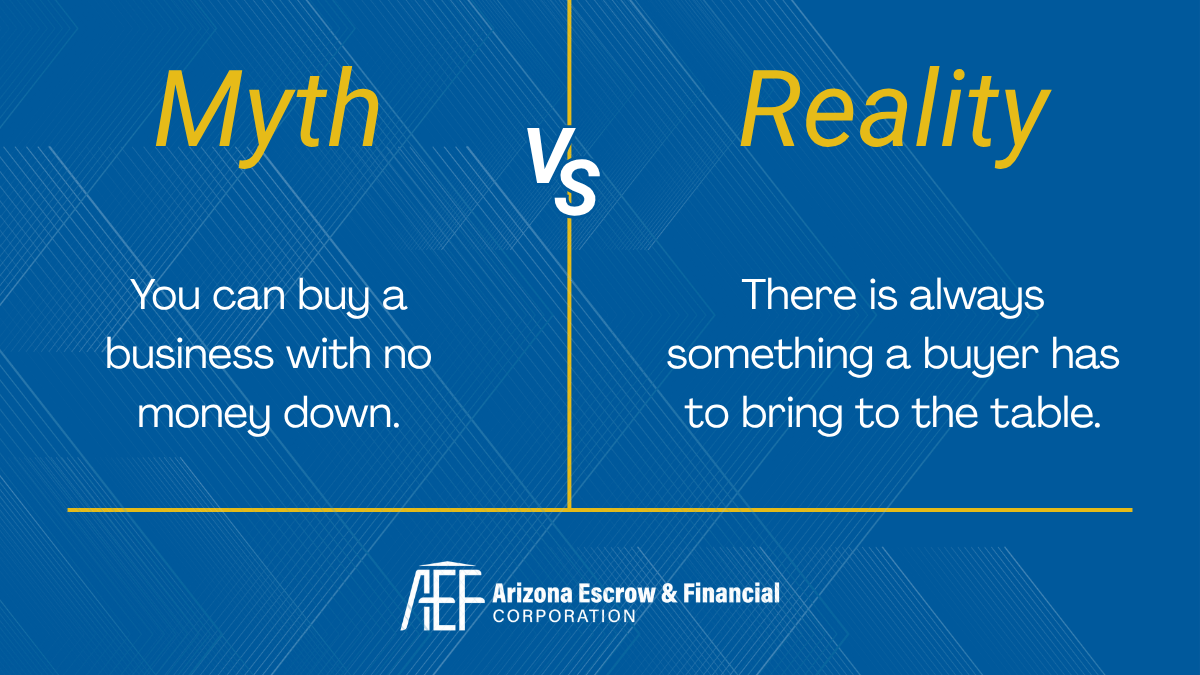
There is always something a buyer has to bring to the table.
At minimum, that means:
- A down payment
- Closing costs
- Working capital
For buyers, the more time spent pursuing unrealistic structures, the longer it usually takes to find a good-fit business and a path to ownership that works.
Financing Options that Reduce Up-Front Costs
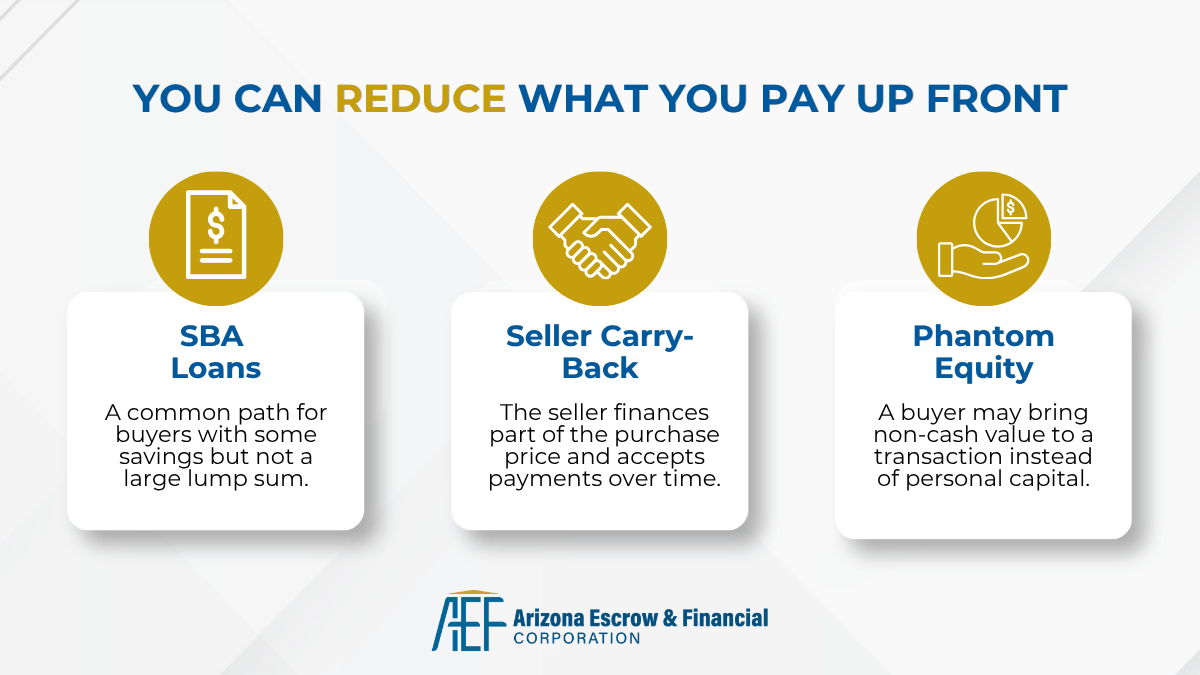
While it is unrealistic to acquire a business without a down payment, there are legitimate financing options that can reduce the amount a buyer pays out of pocket up front. Three of which are:
SBA Loan
A SBA loan is a common path for buyers who have some savings but not a large lump sum.
A SBA loan typically requires a minimum of 10% down, depending on the bank. So on a $1 million business, a buyer needs roughly $110,000 in liquid assets to cover the down payment and closing costs.
Seller Carry-Back
A seller may agree to finance a portion of the purchase price, accepting payments over time rather than a full cash payment at closing. I’ve seen sellers carry between 10-50% of the purchase price.
This can be a useful part of a transaction structure when a buyer is otherwise qualified. What it usually cannot do is entirely replace a down payment.
Phantom Equity
In rare cases, a buyer may bring non-cash value to a transaction, like phantom equity (compensation earned over time that converts to real value upon sale).
I worked on a phantom equity transaction. The buyer was a long-tenured manager purchasing the business he helped run for 15 years. The purchase price is 3 million. He had $300,000 in phantom equity. Unfortunately, the terms with the SBA lender did not lead to success.
This may look like zero down because he isn’t writing a check from his personal account, but that $300,000 is still his money.
What Sellers Need to Know
This issue matters just as much for business owners considering a sale.
When an undercapitalized buyer approaches a seller, the risk falls largely on the seller.
- If the buyer can’t make payments on a seller-carried note, the seller doesn’t get paid.
- If the buyer doesn’t have the working capital to sustain operations, the business and the legacy the seller spent years building can suffer.
The question a seller should always ask is: if a bank wouldn’t approve this buyer, why should I?
There’s also a confidentiality risk. Some buyers pursuing zero-down strategies request access to financials on multiple listings simultaneously as part of the process they’ve been taught.
Never share sensitive business details with a buyer who hasn’t demonstrated the financial standing to complete the transaction.

Entertaining an undercapitalized buyer almost always ends in disappointment, wasted time, and disruption to the business.
Working with qualified, trusted professionals helps sellers move forward with confidence, knowing that the buyers who reach their table are serious, prepared, and capable of closing.
What Brokers Should Do
Most buyers arriving with zero-down expectations aren’t acting in bad faith. They’ve simply been given incomplete information and believe they have a workable plan.
It falls to us to educate and redirect. But when you don’t have that conversation early, the consequences can be significant for you and your clients.
- Legal exposure: If a transaction proceeds on a shaky foundation and falls apart, lawsuits may follow. When people believe they’ve lost something, they look for someone to hold responsible.
- Reputational damage: Transactions that fail because a buyer was not truly qualified negatively impact your reputation with your clients and in the industry.
- Your seller’s legacy: The outcome affects your client’s employees, reputation, and the community they built.
A Practical Framework for Zero-Down Conversations
Start with a personal financial statement early: Some buyers who mention zero-down actually do have capital and simply misunderstand how the financing works. You’ll know either way quickly.
Establish the floor upfront: Be clear about how much liquid capital is required, in dollar terms, for the specific business they’re pursuing. If a buyer doesn’t meet that threshold, say so directly, and help them understand what they’d need to get there.
Ask them to walk you through the numbers: Have them explain what they mean by cash flow, how they understand the business valuation, and how they expect the financing to be structured.
Redirect, don’t reject: The goal isn’t to turn buyers away, it’s to give them an accurate picture of where they stand and what a realistic path forward looks like. Even if they’re not ready now, buyers who are treated with respect are more likely to come back when they are ready.
Protect your seller’s confidentiality as a non-negotiable: A buyer who isn’t financially qualified to close should not have access to your client’s financials.

A Case for More Shared Expectations
In my view, the industry would benefit from greater consistency, especially because there isn’t a single national standard for every situation.
Arizona is a licensed state, which serves as a baseline, but even licensing doesn’t provide deep education in business brokerage. Much of that education has to come through experience, mentorship, professional organizations, and continued training.
It’s a significant reason organizations like the International Business Brokers Association (IBBA) and M&A Source matter.
The stakes extend beyond any single transaction.
A community is only as strong as its businesses.
Local businesses are part of the fabric of their communities. They provide revenue, jobs, volunteer support, and economic activity. When acquisitions fail or do not move forward, the effects can reach employees, families, vendors, customers, and the broader community.
The goal isn’t to block buyers. It’s to help serious buyers become better prepared buyers and to support transactions that have a stronger chance of succeeding after closing.
Preparation Is the Strategy
Buying a business is one of the most significant financial decisions a person can make. It deserves serious preparation, qualified guidance, and honest conversations.
The online content promising zero-down acquisition isn’t going away. But brokers, attorneys, lenders, and industry professionals have both the opportunity and the responsibility to counter it with something better: accurate information and the kind of guidance that actually gets transactions to the closing table.
More importantly, preparation helps an acquisition succeed well beyond closing. Shortcuts may attract attention, but lasting success depends on preparation, credibility, and guidance.
Disclaimer: Arizona Escrow & Financial Services makes no express or implied warranty regarding the accuracy, completeness, or reliability of the information provided and assumes no responsibility for errors or omissions. The information presented is for general informational purposes only and should not be considered legal, financial, or professional advice.
Arizona Escrow & Financial Services, the Arizona Escrow logo, and www.arizonaescrow.com are trademarks or registered trademarks of Arizona Escrow & Financial Services and/or its affiliates. Unauthorized use of these trademarks is strictly prohibited.
For more information, please visit www.arizonaescrow.com or contact us directly.

Lisa Riley
Lisa Riley (PhD, MCBI, CM&AP) is the founder and CEO of Delta Business Advisors and a Master Certified Business Intermediary with more than 15 years of experience facilitating business acquisitions and sales in the lower middle market and main street sectors. She served as chair of the International Business Brokers Association (IBBA) in 2021 and currently leads the IBBA/M&A Source Market Pulse Survey. She works with buyers, sellers, and brokers across Arizona and nationally to navigate complex transactions with clarity and precision.
Disclaimer: Arizona Escrow & Financial Services makes no express or implied warranty regarding the accuracy, completeness, or reliability of the information provided and assumes no responsibility for errors or omissions. The information presented is for general informational purposes only and should not be considered legal, financial, or professional advice.
Arizona Escrow & Financial Services, the Arizona Escrow logo, and www.arizonaescrow.com are trademarks or registered trademarks of Arizona Escrow & Financial Services and/or its affiliates. Unauthorized use of these trademarks is strictly prohibited.
For more information, please visit www.arizonaescrow.com or contact us directly.